Photo: weston m via Unsplash (Unsplash License)
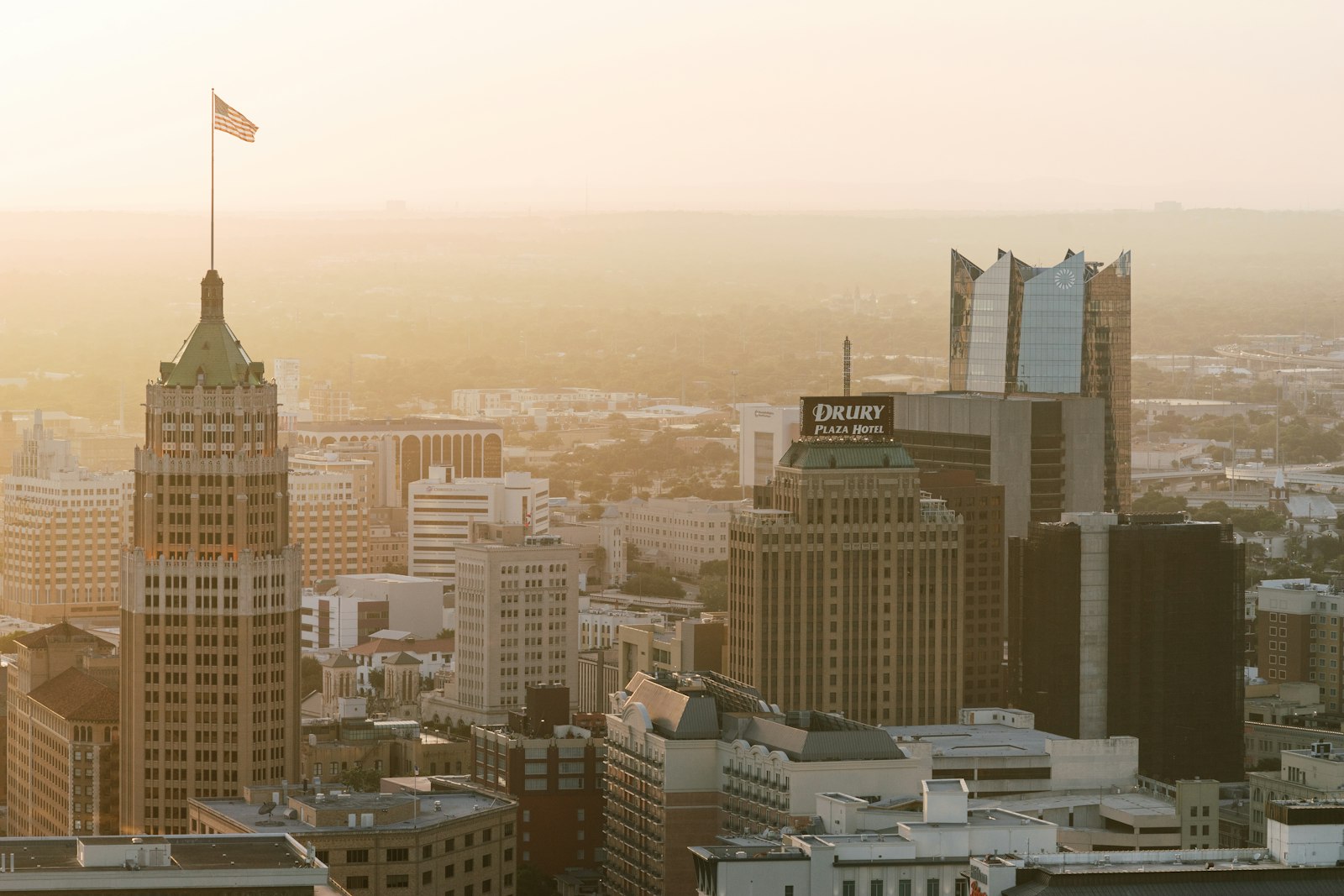
Quick Answer: San Antonio is one of Texas’ fastest-growing data center markets, with about 104 facilities run by 32 providers and 15 under construction, according to Baxtel’s market tracker as of November 2026. Growth is concentrated on the far Northwest Side along Omicron Drive and west into Medina County near Castroville, led by Microsoft, CyrusOne, Vantage and Amazon, while CPS Energy weighs large-customer requests well above its current system peak.
How big is the San Antonio data center market in 2026?
By the count of Baxtel, a data center research platform, the San Antonio market had 104 data centers operated by 32 providers as of its November 2026 market page, with 15 more under construction. Baxtel ranks San Antonio as the 16th-largest data center market in the United States and says the market’s power capacity has grown 81% since 2022. The largest single facility on its list is Microsoft’s San Antonio data center at 50 megawatts.
Other counts are narrower because they use different boundaries. CPS Energy and the San Antonio Water System told City Council members in March 2026 that there were more than 20 data centers in the area, with more coming, Texas Public Radio reported. A Texas Tribune tally cited by the San Antonio Report and Texas Public Radio in August 2026 found more than 30 data centers built in Bexar County, with at least 23 more planned. Baxtel’s broader number includes enterprise, government and smaller colocation sites across the metro, while the utility and county figures focus on larger standalone facilities.
CoStar reported on September 14, 2026 that 2025 set the record for the most data centers built in a single year in San Antonio. CoStar also said the market may be moving past a peak in its build-out, with the construction pipeline beginning to shrink slightly even as the number of proposed projects remains high.
San Antonio data center market snapshot
| Measure | Figure | Source / as of |
|---|---|---|
| Data centers tracked (metro) | 104, run by 32 providers | Baxtel, Nov. 2026 |
| Under construction | 15 facilities | Baxtel, Nov. 2026 |
| U.S. market rank | 16th | Baxtel, Nov. 2026 |
| Power growth since 2022 | 81% | Baxtel, Nov. 2026 |
| Bexar County data centers built / planned | 30+ built; at least 23 planned | Texas Tribune research via TPR, Aug. 2026 |
| CPS Energy large-customer requests at intake | About 9,500 MW vs. system peak of about 6,000 MW | Baxtel, citing June 2025 data |
| ERCOT South Central weather zone base large load | 6,747 MW | Baxtel, Sept. 2026 |
| Record construction year | 2025 | CoStar, Sept. 14, 2026 |
Who are the largest data center operators in San Antonio?
Microsoft dominates the market by operating power. Baxtel’s provider table lists Microsoft Azure with 23 operational sites and about 493.85 megawatts of operational power in the San Antonio market, out of 26 sites tracked. CyrusOne follows with six operational sites and 75 megawatts, Oracle with three sites and 64.25 megawatts, and Vantage Data Centers with two sites and 64 megawatts.
| Provider | Operational sites | Operational MW | Total sites tracked |
|---|---|---|---|
| Microsoft Azure | 23 | 493.85 | 26 |
| CyrusOne | 6 | 75.0 | 9 |
| Oracle | 3 | 64.25 | 5 |
| Vantage Data Centers | 2 | 64.0 | 4 |
Source: Baxtel San Antonio market page, November 2026.
Other operators Baxtel lists in the metro include AT&T, Lumen, QTS, Stream, CloudHQ, Google, Amazon Web Services, Rowan, Tract and Cipher Digital, along with enterprise and government users such as Valero, Frost Bank, CHRISTUS Health, Lowe’s, the NSA and the Defense Information Systems Agency.
How did San Antonio become a data center hub?
Baxtel’s timeline traces the market’s modern era to Microsoft, which broke ground in July 2007 and opened a $550 million facility in September 2008. CyrusOne opened its first San Antonio building in October 2012. Amazon Web Services fitted out its first local data center in 2021, QTS opened a three-story building on Potranco Road in 2022, Microsoft brought its first Castroville building online in 2024 and Vantage opened its first local floor in 2025.
Where are new San Antonio data centers being built?
What is happening on Omicron Drive?
Omicron Drive, a roughly two-mile road in the Texas Research Park at the western edge of Bexar County, has become the market’s densest cluster. CyrusOne and Vantage have registered more than $1 billion in construction there since 2020, based on Texas Department of Licensing and Regulation (TDLR) cost estimates reported by the San Antonio Report and Texas Public Radio. The research park is zoned for heavy industrial use.
CyrusOne’s Omicron campus covers 22 acres and has two operating facilities and two under construction, with three more planned on a nearby parcel, the San Antonio Report reported after a September 24, 2026 media tour. Its SAT 5 building is 87,500 square feet. The company’s first San Antonio buildings, SATs 1 through 4, sit in Westover Hills off State Highway 151. CyrusOne built an electrical substation for the campus and transferred it to CPS Energy, and company representatives said the facility uses a closed-loop cooling system. Vantage, based in Denver, has a campus of more than 50 acres in the area and filed plans earlier in 2026 for a 96-megawatt data center costing close to $500 million.
Why is Medina County drawing hyperscalers?
The second growth corridor runs west along U.S. Highway 90 into Medina County. Microsoft’s Castroville-area campus has expanded in stages. A 2024 TDLR filing, reported by the San Antonio Business Journal and Commercial Property Executive, described a third building of about 244,000 square feet with a tentative value of $483 million, with construction planned to begin in April 2026 and completion expected in the first quarter of 2028. In March 2026, Texas Public Radio reported that TDLR filings showed Microsoft planning two additional data centers at its County Road 381 site in Rio Medina, together nearly half a million square feet and $52 million in filed cost, with work starting that spring.
CyrusOne is also building in Medina County. Its site near Castroville covers 250 acres along U.S. 90 West next to a Microsoft data center, the San Antonio Report said. Baxtel lists CyrusOne’s Castroville SAT14A building at 460,000 square feet and 108 megawatts, the largest project on its San Antonio under-construction list.
Which other projects are under construction or planned?
| Project | Size | Power / cost | Source |
|---|---|---|---|
| CyrusOne Castroville SAT14A | 460,000 sq ft | 108 MW | Baxtel |
| Plaza Alpha | 195,670 sq ft | 62 MW | Baxtel |
| Rowan Cinco | n/a | 60 MW | Baxtel |
| Park Beta | 141,979 sq ft | 14 MW | Baxtel |
| Microsoft Rio Medina (2 buildings) | ~500,000 sq ft combined | $52 million filed cost | TPR, Mar. 2026 |
| Amazon, Donop Road (Southeast Side) | 100,000+ sq ft | $65 million | TPR, Mar. 2026 |
| Amazon, Northwest Crossroads (West Side) | 100,000+ sq ft | $25 million | TPR, Mar. 2026 |
| Vantage, Omicron area | n/a | 96 MW; ~$500 million | San Antonio Report, Oct. 2026 |
TDLR filed values reflect the scope of work listed in each filing, so they are not a full measure of total project spending and are not directly comparable from one project to the next. Amazon’s two projects were expected to finish within two to three years, Texas Public Radio reported. Stream Data Centers, which broke ground in June 2024 on its third San Antonio-area project, planned a campus of up to five buildings totaling 1.5 million square feet and up to 200 megawatts, according to Commercial Property Executive.
How does San Antonio compare with other data center markets?
San Antonio’s build-out is happening inside one of the tightest national markets on record. CBRE’s North America Data Center Trends report for the first half of 2026, published August 27, 2026, put vacancy across its primary markets at a record-low 1.4%, down from 1.6% a year earlier. Supply in those markets reached 10,903 megawatts, up 33.7% year over year, and a record 7,481.1 megawatts were under construction, 80.4% of it already committed to tenants. Asking rents rose across all requirement sizes, including 8.3% for 3-to-10-megawatt deals.
Next door, CBRE’s profile of Austin for the first half of 2025 reported 2.3% vacancy and 462.0 megawatts under construction, 97% of it preleased, with developers shifting toward Austin’s northeast suburbs and south into Lower Colorado River Authority territory as regional utilities fielded historically large power requests. CBRE’s 2026 report also flagged West Texas, where projects in seven counties reached energization milestones, as a region it expects to become one of North America’s top five colocation markets by 2028. For San Antonio, that means competition for hyperscale demand is coming from both directions along Interstate 35 and from power-rich sites farther west.
Can CPS Energy and SAWS keep up with data center demand?
Power is the market’s binding constraint. Baxtel reports that CPS Energy logged about 9,500 megawatts of large-customer requests at intake in June 2025, against a system peak of roughly 6,000 megawatts. Not every request becomes a project, but the ratio shows how quickly large-load interest has outrun the existing system. In September 2026, ERCOT classified 6,747 megawatts of base large load in its South Central weather zone, which includes the San Antonio region, according to Baxtel.
Executives from CPS Energy and the San Antonio Water System told City Council in March 2026 that they were confident they could meet the industry’s demand, while residents raised concerns about water used for cooling during drought, electricity demand and noise, Texas Public Radio reported. Both utilities said in March that they are monitoring growth from large customers. The Greater Edwards Aquifer Alliance released an April 2026 report covering 21 counties that recommends investment in water and energy infrastructure.
Operators are responding partly with design choices. CyrusOne told visitors its Omicron facility uses closed-loop cooling, and its generators sit inside 4-inch-thick sound-attenuating walls, with only a few running at once for brief daytime periods, with noise checked at the property fence line, the San Antonio Report reported.
What does San Antonio get from data centers in jobs and taxes?
The trade-off debate in San Antonio centers on capital investment versus employment. Jeff Webster, president and CEO of the Greater San Antonio Chamber of Commerce, has said the projects bring significant capital investment and tax revenue. The Data Center Coalition’s Dan Diorio said data centers generated $4.5 billion in Texas state and local revenue in 2024. On the other side, Public Citizen estimates 24 to 36 workers per 150,000 square feet of data center, and the San Antonio Report noted that Toyota’s South Side rear axle plant is just over three times that size but employs more than 11 times as many workers.
Is San Antonio changing its data center rules?
The City of San Antonio has convened stakeholders on data center regulation. Mayor Gina Ortiz Jones backed expediting amendments to the Unified Development Code, while some council members preferred to wait until 2027, according to the August 2026 report. The Greater Edwards Aquifer Alliance has recommended repealing state data center tax incentives and charging impact fees. Elsewhere in the state, Harlingen approved a 120-day moratorium. Dallas Fed economist Pia Orrenius said in February 2026 that Texas ranks second only to Virginia in the data center industry.
Frequently Asked Questions
How many data centers are in San Antonio?
Baxtel counts 104 data centers run by 32 providers in the San Antonio market as of November 2026, with 15 under construction. Narrower counts by local utilities and the Texas Tribune range from more than 20 to more than 30 larger facilities.
Which company has the most data center capacity in San Antonio?
Microsoft. Baxtel lists Microsoft Azure with 23 operational sites and about 494 megawatts of operational power in the market, far ahead of CyrusOne, Oracle and Vantage.
Why are data centers clustering in Medina County?
Large tracts along U.S. 90 near Castroville offer room for multi-building campuses next to existing hyperscale sites. Microsoft and CyrusOne both have campuses there, including CyrusOne’s 250-acre site.
Do San Antonio data centers use a lot of water?
Water use varies by cooling design. CyrusOne says its Omicron facility uses closed-loop cooling. SAWS has told City Council it is monitoring growth from large customers.
Is San Antonio data center construction slowing?
CoStar reported in September 2026 that the construction pipeline has begun to shrink slightly after a record 2025, but the number of proposed projects remains high.
Sources and Further Reading
- San Antonio Data Center Market — Baxtel
- Data Centers Are Cropping Up All Over Bexar County, With 23 More on the Way — Texas Public Radio / San Antonio Report
- San Antonio, Medina County Continue to Attract Data Centers — Texas Public Radio
- Can Small-Group Tours of Data Centers Change Hearts and Minds? — San Antonio Report
- Despite Record-Breaking Year, More Data Center Construction Lies Ahead for San Antonio — CoStar
- Microsoft Boosts Data Center Capacity in San Antonio Region — Commercial Property Executive
- North America Data Center Trends H1 2026 — CBRE
- North America Data Center Trends H1 2025: Austin-San Antonio Market Profile — CBRE