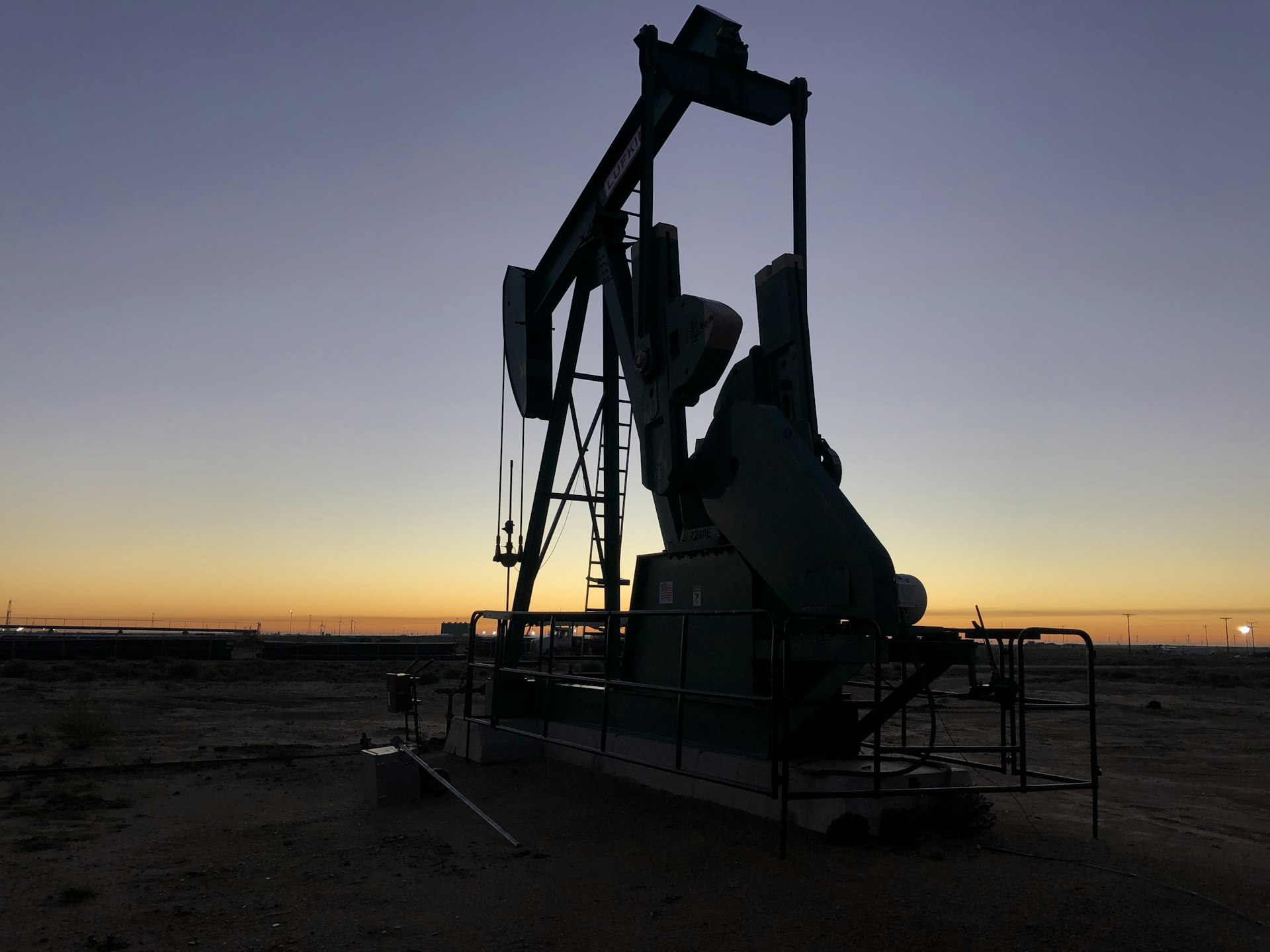
Photo: Delfino Barboza via Unsplash (Unsplash License)
Quick Answer: Developers in West Texas and the Panhandle are pairing data center campuses with their own gas-fired power plants instead of waiting on the grid. As of November 19, 2026, Pacifico Energy holds a 7.65-gigawatt state air permit for its GW Ranch project in Pecos County, and Fermi America has a $200 million prepayment agreement from an unnamed hyperscaler for an initial 600 megawatts at its Amarillo-area Project Matador. Neither campus has delivered power to a customer yet.
Why are Texas data center developers building their own power plants?
The short answer is time. Grid capacity for very large loads has become the scarcest input in the Texas data center business, and developers with access to cheap Permian natural gas are betting they can deliver power faster by generating it on site. Pacifico Energy describes its GW Ranch campus as a “private-grid” project that it says does not affect the electricity grid or raise energy costs for Texans. Fermi America’s chief executive, Lee McIntire, summed up the sales pitch alongside the company’s November 12, 2026 results, saying hyperscalers want sites that are ready with permitted power, according to Baxtel’s account of the release.
The regulatory backdrop reinforces that pitch. Baxtel’s market timeline reports that in August 2026 ERCOT paused energization approvals for new data centers of 75 megawatts or more, following the interconnection standards for large loads that the Legislature set in 2025. A campus that does not depend on a grid connection for its first phase sidesteps at least part of that queue.
The scale of the trend is large. Global Energy Monitor data released January 29, 2026, and reported by Inside Climate News, showed the Texas gas power pipeline grew by nearly 58 gigawatts in 2025, more than California’s peak power demand. About 40 gigawatts, nearly half of the state’s upcoming gas projects, would directly power data centers. Texas had 11 gas projects under construction, 102 in preconstruction and 28 announced, and only China had more gas power projects in development. Nationally, Cleanview’s tracker counts 59 behind-the-meter data centers with roughly 90 gigawatts of planned self-generation.
What is GW Ranch, and how big is it?
GW Ranch is Pacifico Energy’s private-grid generation campus in Pecos County, in the Permian Basin. In a January 26, 2026 release, the company said it had received a Texas Commission on Environmental Quality (TCEQ) air permit for 7.65 gigawatts of gas-fired generation, which it called the largest permit granted in the United States. Pacifico, founded in 2009 and based in San Juan Capistrano, California, says the site covers more than 8,000 build-ready acres with room to expand.
What does the GW Ranch plan include?
| Item | Detail (as of Jan. 26, 2026 release) |
|---|---|
| Location | Pecos County, West Texas |
| Site | 8,000+ acres |
| Permitted gas generation | 7.65 GW (TCEQ air permit) |
| Battery storage | 1.8 GW |
| Solar | 750 MWac |
| Gas supply | Multiple laterals, including a 15-mile, 1 Bcf/d pipeline to the Waha hub |
| Phase 1 | 1 GW gross, first power targeted for first half of 2027 |
| Stated path | Scale to more than 5 GW |
The company’s project development lead said site delineations were complete, permits were in hand and turbines were secured. The release did not name a data center tenant, a total project cost or the battery duration.
What did the GW Ranch permit authorize in emissions?
Inside Climate News reviewed the permit documents and reported that they authorize more than 12,000 tons per year of regulated pollutants, including soot, ammonia, carbon monoxide and volatile organic compounds, plus up to 33 million tons per year of greenhouse gases, which the outlet compared with nearly 5% of Canada’s total annual emissions. Gabriel Collins of Rice University’s Baker Institute estimated that at full capacity the project could burn 1 to 2 billion cubic feet of gas per day, equal to 4% to 7% of Permian Basin gas output in 2025.
What is Fermi America’s Project Matador?
Fermi America, now reporting as Fermi Inc., is developing Project Matador, which it also calls its HyperGrid campus, outside Amarillo on land leased from the Texas Tech University System. The company applied for air permits in August 2025 for 6 gigawatts of gas-fired power, and Inside Climate News reported those plants could release up to 24 million tons per year of greenhouse gases. Fermi says the campus could ramp to about 17 gigawatts, subject to binding customer agreements, additional permits, financing, interconnection and land acquisition. Baxtel currently tracks 2,466 megawatts at the campus.
What changed in Fermi’s November 2026 update?
Fermi’s third-quarter release, filed with the SEC on November 12, 2026, described a new set of agreements with an undisclosed, investment-grade hyperscaler to advance an initial 600 megawatts, with development beginning in 2027:
- A $200 million prepayment agreement providing upfront customer funding.
- A $15 million early construction and site development agreement covering site preparation.
- A $90 million structural steel and building materials purchase agreement, still being finalized, that would let the customer use long-lead materials Fermi bought in advance.
No definitive long-term lease had been signed as of the release. In the same filing, Fermi disclosed that its Data Center Lease and Services Agreement with TensorWave, signed in August 2026, had been terminated, along with the related AMD credit support agreement. Baxtel reported in October that the TensorWave lease covered 222 megawatts of facility power and about $6.5 billion in contracted revenue over 15 years, with expansion rights that could have exceeded 650 megawatts.
Fermi also said the Texas Tech University System partnership remains strong and that conditions under the land lease must be met before vertical construction begins. Baxtel reported that Chancellor Brandon Creighton said the system remains committed to the project.
How is Fermi financed, and what do its numbers show?
| Metric (Fermi Inc.) | Quarter ended Sept. 30, 2026 |
|---|---|
| Revenue status | Pre-revenue, development stage |
| Net loss, Q3 | $141.6 million ($0.22 per share) |
| Net loss, nine months | $356.1 million |
| G&A expense, Q3 | $142.2 million (incl. $65.8 million non-cash stock compensation) |
| Cash and restricted cash | $315.5 million ($286.3 million unrestricted) |
| Debt, net | $958.4 million, up $463.0 million in the quarter |
| Property, plant and equipment, net | About $1.67 billion |
| Capital invested in PP&E | $133.4 million in Q3; $759.5 million year to date |
Fermi says it has invested nearly $1.7 billion in the site to date and that capital spending will track commercial commitments. Chief financial officer Rob Masson said funding is shifting from corporate cash toward customer prepayments and project-level debt and equity, according to Baxtel. The quarter’s debt increase came from net borrowings under convertible notes and equipment financing. Baxtel noted that Fermi shares closed at $1.91 on November 12, up 5.52% on the day but about 91% below their 52-week high, citing Investing.com.
Which other private power projects are tied to Texas data centers?
GW Ranch and Project Matador are the largest, but they are not alone. Inside Climate News and Route Fifty reported these additional projects:
| Project | Location | Capacity | Status reported |
|---|---|---|---|
| GW Ranch (Pacifico Energy) | Pecos County | 7.65 GW gas | TCEQ air permit, Jan. 2026 |
| Project Matador (Fermi) | Near Amarillo | 6 GW gas applied for | Air permits applied for Aug. 2025 |
| Chevron power project | West Texas Permian | Up to 5 GW | Announced Nov. 2025 |
| Sandow Lakes Power Plant | Blue, Lee County | 1.2 GW | Permitted Oct. 2025; construction started |
| Misae Gas Power | Outside San Antonio | 519 MW (206 generators) | Permit granted Jan. 14, 2026 |
The Misae permit moved quickly: the application was filed December 23, 2025, and TCEQ granted it on January 14, 2026, authorizing 133 tons per year of particulate matter and 10 tons per year of formaldehyde. The Sandow Lakes plant in Lee County, about 50 miles east of Austin, sits near what the reports describe as North America’s largest bitcoin mining facility.
Where is West Texas data center power actually coming online?
CBRE’s North America Data Center Trends report for the first half of 2026, dated August 27, 2026, said West Texas projects in Armstrong, Wilbarger, Haskell, Gray, Roberts, Ector and Reeves counties reached energization milestones during the period. CBRE expects the region to become one of the top five colocation markets in North America by 2028. That is a notable call for an area that had little data center inventory a few years ago, and it rests on the same factor driving GW Ranch and Matador: available power.
The national market explains why tenants are willing to look that far west. Across CBRE’s primary North American markets, vacancy fell to a record-low 1.4% in the first half of 2026, capacity under construction hit a record 7,481.1 megawatts, and 80.4% of that under-construction capacity was already committed. Asking rents rose across all requirement sizes, including an 8.3% gain for 3-to-10-megawatt deals.
What are the main risks for private-grid campuses?
Will all of the announced capacity get built?
Probably not all of it, by the developers’ own framing. Fermi’s 17-gigawatt figure is explicitly conditioned on binding customer agreements, more permits, financing and land. Collins told Inside Climate News he expects some announced projects not to be built and expects those that are built to come online gradually, roughly 100 megawatts at a time over several years.
What does the Fermi-TensorWave reversal show?
It shows how much a single tenant contract matters to a pre-revenue power developer. A signed 15-year lease was replaced, within about three months, by a larger but not yet definitive hyperscaler arrangement backed by prepayments. The prepayment structure moves some construction funding onto the customer, but until a long-term lease is signed, the revenue line remains a projection.
What about emissions and gas supply?
Permits for these campuses authorize greenhouse gas volumes measured in tens of millions of tons a year, and full build-out at GW Ranch alone would draw a meaningful share of Permian gas. Both factors invite scrutiny from regulators, neighbors and customers with emissions targets, and neither is resolved by building off the grid.
Brian’s Take
What strikes me here is the gap between permits and paying customers. Pacifico has the biggest air permit in the country, and Fermi has nearly $1.7 billion sunk into its site, yet as of this week neither has a disclosed, signed long-term data center lease generating revenue. Fermi’s numbers make the point plainly: $958 million of net debt, a $141.6 million quarterly loss and a business model that now leans on customer prepayments to keep building.
That said, the underlying logic is sound. Vacancy in major markets is at record lows, grid queues for big loads are getting tighter, and West Texas has gas, land and pipelines. A hyperscaler willing to put $200 million down before signing a lease tells you how much it values permitted power. For Texas contractors, pipeline operators and Panhandle and Permian counties, the opportunity is real, but I would watch for signed leases and first power in 2027 before treating any gigawatt headline as a done deal.
Frequently Asked Questions
What does “behind-the-meter” mean for a data center?
It means the data center gets power from generation built on or next to its site rather than drawing all of it from the utility grid. In Texas, most new behind-the-meter projects use natural gas turbines or engines, sometimes paired with batteries and solar.
Is GW Ranch disconnected from ERCOT?
Pacifico calls GW Ranch a private-grid project that it says will not affect the electricity grid or raise costs for Texans. Its January 2026 release did not describe any ERCOT interconnection arrangement.
Who is Fermi America’s new customer?
Fermi has not named it. The company describes it only as an investment-grade hyperscaler advancing an initial 600 megawatts at Project Matador, with development starting in 2027.
Why did the TensorWave lease end?
Fermi’s November 12, 2026 release said the August 2026 lease and the related AMD credit support agreement were terminated. The release did not give a detailed reason.
How much gas could GW Ranch use?
Gabriel Collins of Rice University’s Baker Institute estimated 1 to 2 billion cubic feet per day at full capacity, or 4% to 7% of 2025 Permian Basin gas output.
When could these campuses deliver power?
Pacifico targets first power from a 1-gigawatt first phase in the first half of 2027. Fermi says development of its first 600 megawatts for the hyperscaler begins in 2027 and has not announced a first-power date.
Sources and Further Reading
- Fermi Announces New Agreements with Investment-Grade Hyperscaler and Third Quarter 2026 Financial Results (Form 8-K, Exhibit 99.1) — U.S. Securities and Exchange Commission
- Fermi Secures 600MW Hyperscaler Deal, Terminates TensorWave Lease — Baxtel
- Pacifico Energy Secures 7.65 GW Power Generation Permit for GW Ranch Project — Business Wire
- Developer Calls GW Ranch in Pecos County, Texas, the ‘Largest Power Project’ in U.S. — Inside Climate News
- In the West Texas Oil Patch, Companies Plan Gas Power Plants to Run New Data Centers — Route Fifty
- North America Data Center Trends H1 2026 — CBRE
- Bypassing the Grid: Behind-the-Meter Data Centers — Cleanview
- San Antonio Data Center Market (timeline of ERCOT large-load actions) — Baxtel