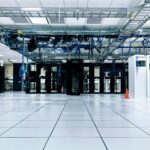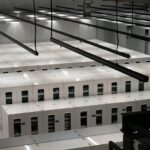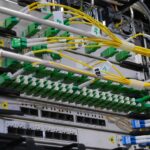
Status lights on server racks inside a high-performance computing data center. Photo: U.S. Department of Energy, via Wikimedia Commons. License: Public domain.
Quick Answer: Texas’s sales and use tax exemption for qualifying data centers cost the state an estimated $1.016 billion in fiscal 2025, and Comptroller forecasts put the cost at $1.753 billion in fiscal 2030. When it was created in 2013, the exemption was expected to cost $14.6 million over its first two years. The Comptroller’s registry now lists 182 registered project entries, and lawmakers began filing repeal bills on Nov. 9, 2026.
Texas created its data center sales tax exemption in 2013 as a modest recruiting tool. It has since grown into a subsidy worth more than $1 billion a year, driven by hyperscale cloud and artificial intelligence demand.
This report draws on Comptroller revenue estimates and certification lists, July 2026 Senate Finance Committee testimony, and repeal bills pre-filed in November 2026. Figures are as of November 2026 unless noted.
What does the Texas data center sales tax exemption cover?
The incentive has two parts. Tax Code Section 151.359 covers a “qualifying data center,” and Section 151.3595 covers a “qualifying large data center project.” The Legislature created the first in 2013 through House Bill 1223, authored by then-Rep. Harvey Hilderbran. It added the large-project tier in 2015.
Under the Comptroller’s program rules, a certified facility can buy necessary equipment without paying the 6.25% state sales and use tax. Exempt items include servers, storage, network gear, racks, cooling and electrical systems, generators and software. Electricity is also exempt, subject to a predominant-use study in most cases. Office and janitorial supplies do not qualify.
For the standard program, the Comptroller says the exemption applies only to the state tax. Local sales and use taxes must still be collected. A single occupant must use the facility without subleasing, and it cannot also hold a Chapter 313 school property tax limitation agreement.
What does a data center have to invest to qualify?
| Requirement | Qualifying data center (Sec. 151.359) | Qualifying large data center project (Sec. 151.3595) |
|---|---|---|
| Year created | 2013 | 2015 |
| Minimum size | 100,000 sq. ft. in a single building | 250,000 sq. ft. in one or more buildings on one site |
| Capital investment | At least $200 million within five years | At least $500 million within five years |
| Qualifying jobs in the county | 20, kept for five years | 40, kept for five years |
| Exemption period | 10 years ($200M to under $250M invested) or 15 years ($250M or more) | 20 years from certification |
| Application form | AP-233 | AP-236 |
Source: Texas Comptroller of Public Accounts, data center exemption program pages; The Texas Tribune.
According to Texas Tribune reporting on the program, qualifying jobs must pay at least 120% of the area’s median wage. Large projects must also reserve at least 20 megawatts of transmission capacity. Companies get five years from certification to reach the investment and job thresholds.
How much revenue does the exemption cost Texas each year?
The Comptroller estimates forgone revenue in its biennial Tax Exemptions and Tax Incidence report. The January 2025 edition, prepared for the 89th Legislature, projected the following annual costs to state revenue. The figures were reproduced in Senate Finance Committee testimony on July 27, 2026, and in an October 2026 working paper from Rice University’s Baker Institute for Public Policy.
| Fiscal year | Estimated state revenue forgone | Implied exempt purchases (at 6.25%) |
|---|---|---|
| 2025 | $1.016 billion | $16.25 billion |
| 2026 | $1.305 billion | $20.88 billion |
| 2027 | $1.598 billion | $25.57 billion |
| 2028 | $1.601 billion | $25.61 billion |
| 2029 | $1.693 billion | $27.09 billion |
| 2030 | $1.753 billion | $28.05 billion |
Source: Texas Comptroller, Tax Exemptions and Tax Incidence (January 2025), as reproduced by Rice University’s Baker Institute for Public Policy. Implied purchases are the revenue estimate divided by the 6.25% state rate.
By budget period, the forecast comes to about $2.9 billion for 2026-27 and about $3.3 billion for 2028-29, the figure Senate Finance used. The $3.2 billion “next two years” figure that has circulated widely since 2025 equals the fiscal 2027 and 2028 estimates added together.
How fast has the cost grown?
When lawmakers created the exemption, the state estimated it would cost about $14.6 million in the 2014-15 budget cycle. The Texas Tribune reported that it cost about $5.4 million in 2015 and stayed between $5 million and $30 million a year from 2014 through 2022. It passed $150 million in 2023. An earlier projection of roughly $180 million for 2027 and 2028 combined was revised in 2025 to more than $3 billion.
The Comptroller’s office has said even the current numbers are probably too low. At the July 27, 2026, hearing, Chief Revenue Estimator Brad Reynolds told senators, “We have vastly, vastly more certifications for exemption that have been granted since that last estimate was done,” as reported by Texas Public Radio. The forecasts also cover only the state sales tax. They leave out local property tax abatements and public spending on power and water infrastructure.
How many data centers are certified for the exemption?
The certified count has grown quickly. In April 2026, the Texas Tribune reported that 121 data centers were receiving the break, according to the Comptroller’s database. At the July hearing, the Comptroller’s office put the number of qualified facilities at 138. It said 59 certifications had been approved so far that year and that it expected about 10 new ones a month. The Baker Institute’s analysis of the same data found that 50 of the 59 fiscal 2026 certifications were in the large-project tier. Only nine large projects had been certified in total through fiscal 2024.
The Comptroller also publishes a list of registered projects. In mid-November 2026, it showed 182 entries: 69 qualifying data center projects and 113 qualifying large data center projects. Entries are not unique buildings; some sites appear in both tiers or in phases.
| Effective-date year | Data center entries | Large project entries | Total |
|---|---|---|---|
| 2013-2020 | 8 | 3 | 11 |
| 2021 | 6 | 0 | 6 |
| 2022 | 11 | 9 | 20 |
| 2023 | 4 | 3 | 7 |
| 2024 | 16 | 8 | 24 |
| 2025 | 9 | 40 | 49 |
| 2026 (through early November) | 15 | 50 | 65 |
| Total | 69 | 113 | 182 |
Source: Texas Comptroller of Public Accounts, registered qualifying data center and large data center project lists; DataCenterNewsTexas tabulation by listed effective date.
Which companies hold the most certifications?
A tabulation of the registry by named occupant or operator shows how concentrated the program is. Oracle entities appear in 26 entries, including a dozen Vantage Data Centers buildings with 2025 effective dates. Google LLC is named in 17 entries, Microsoft in 15, Amazon Data Services in 14 and CoreWeave in 9. Anthropic is listed as the occupant of three large projects. Bitcoin mining and hosting firms such as Riot Platforms and Cipher Mining also appear.
Are certified data centers meeting the job and investment requirements?
The Comptroller audits each facility at its five-year anniversary and reviews job reports every year. Because most certifications are recent, few facilities have reached that point. At the July hearing, the agency said 20 of the 138 certified data centers had been audited. Six were found out of compliance. At least four had not created the required jobs, one had not built the required square footage, and one reported that its required power agreement had fallen through. Facilities that lose certification owe the waived tax plus penalty and interest from the date of each purchase.
Senators questioned whether the checks are tough enough. “No tax exemption should operate on autopilot,” said Sen. Joan Huffman, a Houston Republican who chairs Senate Finance. The Data Center Coalition defended the policy, and a PwC study commissioned by the coalition estimated that data centers added $65.8 billion to Texas GDP in 2024 and supported more than 103,000 jobs.
What changed in the 2025 legislative session?
The 89th Legislature did not change the exemption’s core thresholds in 2025. The Comptroller’s program page, last updated in July 2026, still lists the size, investment and job requirements set in 2013 and 2015. At least one 2025 bill would have tightened the program. Senate Bill 2888, filed by Sen. Cook, would have added energy-efficiency conditions, such as liquid or rack-based cooling and Energy Star-certified servers, for certifications made on or after Sept. 1, 2026. Those conditions do not appear in the Comptroller’s current requirements.
The biggest 2025 change was the Comptroller’s sharply higher January 2025 forecast. Bills to adjust the Jobs, Energy, Technology and Innovation (JETI) Act, SB 2322 and HB 105, also failed, according to a Bracewell summary.
What has happened since the session ended?
On June 9, 2026, Gov. Greg Abbott released recommendations for the 2027 session. They included repealing the data center sales tax exemption and “other outdated or unnecessary incentives for data centers,”. Senate Finance held its interim hearing on the exemption on July 27.
On Nov. 9, 2026, the first day of bill pre-filing for the 90th Legislature, lawmakers filed at least five bills aimed at the exemption.
| Bill | Author | Treatment of existing certifications |
|---|---|---|
| SB 293 | Sen. Joan Huffman, R-Houston, with a majority of senators as joint authors | Existing exemptions would end on the effective date; pending applications denied |
| HB 167 | Rep. Trey Martínez Fischer, D-San Antonio | Certified projects keep the exemption until it expires |
| HB 681 | Rep. Vasut | Certified projects keep the exemption until it expires; pending applications denied |
| HB 408, HB 750 | Not reported | Also target the exemption |
Source: Texas Legislature Online; Foley & Lardner; FOX 4 News.
HB 681 would repeal Sections 151.359 and 151.3595. It would take effect immediately with a two-thirds vote in each chamber, or on Sept. 1, 2027, otherwise. The Legislature convenes Jan. 12, 2027. At 6.25%, a $1 billion equipment purchase would carry $62.5 million in state sales tax, so grandfathering matters.
What local tax incentives do Texas data centers receive?
Local property tax deals are harder to total. Chapter 313 of the Tax Code, the old school-district value limitation program, stopped taking applications after Dec. 31, 2022. Under the Comptroller’s rules, a facility under a Chapter 313 agreement cannot also be certified for the sales tax exemption.
The JETI Act replaced Chapter 313 under House Bill 5 in 2023, effective Sept. 1, 2023. Its categories include manufacturing, dispatchable power, research and development, and critical infrastructure; data centers are not listed. A JETI agreement limits a project’s taxable value for school maintenance and operations taxes over 10 years. The limit is 100% during construction and 50% after.
As a result, JETI’s link to data centers is mostly indirect. Public Citizen reviewed Comptroller files for testimony at the July hearing and counted 15 active JETI projects as of January 2026. At least two involve gas-fired power tied to data center demand: Stone Creek Peaker, a 200-megawatt plant in Brazoria County, and Energy Forge One, a proposed 2-gigawatt plant in Reeves County.
Chapter 312 abatements and Chapter 380 and 381 economic development agreements are the main local tools. In the Comptroller’s local development agreement database, Public Citizen identified 33 agreements with data centers, 20 with cities and 13 with counties. Sen. Judith Zaffirini’s pre-filed SB 36 would bar data centers from Chapter 312, 380 and 381 abatements and rebates and prohibit renewing existing agreements.
How are data centers showing up on local tax rolls?
The Baker Institute cited a June 2026 Comptroller survey of appraisal districts. Of 253 districts, 117 responded. They reported 197 data centers with market value on the 2025 rolls and 226 on the 2026 rolls. That counts tax-roll property, not certifications.
Key facts snapshot
| Measure | Figure |
|---|---|
| Original cost estimate, 2014-15 | About $14.6 million |
| Estimated cost, FY2025 | $1.016 billion |
| Estimated cost, FY2030 | $1.753 billion |
| Certified facilities (July 2026) | 138 |
| Registry entries (November 2026) | 182 (69 standard, 113 large) |
| Audited / found noncompliant | 20 / 6 |
| Repeal bills pre-filed Nov. 9, 2026 | At least 5 |
Source: Texas Comptroller of Public Accounts; Texas Senate Finance Committee testimony; Rice University’s Baker Institute for Public Policy.
Frequently Asked Questions
What happens if a data center misses its job targets?
The Comptroller revokes certification. The company then owes the waived tax plus penalty and interest on all exempt purchases.
Would repeal take away exemptions already granted?
It depends on the bill. HB 167 and HB 681 would let certified projects keep their exemptions until they expire. Huffman’s SB 293, as described by her office, would end existing exemptions on its effective date.
When could a repeal take effect?
The 90th Legislature convenes Jan. 12, 2027. HB 681 would take effect immediately with a two-thirds vote in each chamber, or Sept. 1, 2027, otherwise.
Sources and Further Reading
- Data Centers: Qualifying Data Center Sales and Use Tax Exemption — Texas Comptroller of Public Accounts
- Registered Qualifying Data Center and Large Data Center Project Lists — Texas Comptroller of Public Accounts
- Tax Exemptions and Tax Incidence: A Report to the Governor and the 89th Legislature (January 2025) — Texas Comptroller of Public Accounts
- JETI Program FAQ; “JETI” Fiscal Notes article — Texas Comptroller of Public Accounts
- How the Data Center Boom Affects the Texas Tax Base — Rice University’s Baker Institute for Public Policy
- Texas data centers sales tax break audits (July 27, 2026) — The Texas Tribune
- Texas is giving data centers more than $1 billion in tax breaks each year (April 2026) — The Texas Tribune
- Texas lawmakers question billions in tax breaks for data centers — Texas Public Radio
- Testimony to the Senate Finance Committee on data center tax breaks (July 27, 2026) — Public Citizen
- Texas Lawmakers File to Repeal the Data Center Sales Tax Exemption — Foley & Lardner
- Texas State Senator Joan Huffman files legislation to repeal data center sales tax exemptions — FOX 4 News
- Abbott recommends sweeping data center regulation, including eliminating sales tax exemption — KSAT
- H.B. 681 and S.B. 2888 bill text — Texas Legislature Online
- Texas Tax Update: Key Changes Enacted During the 89th Legislature — Bracewell